
The New Hot War on Women’s Rights: 30 Years Post-Beijing
This contribution is an overview of the GRAN-ESC blog series “The New Hot War on Women’s Rights: 30 Years Post-Beijing.” The series brings together regional and thematic reflections, some of which explore backlash while others focus more broadly on evolving gender equality debates. At the 2025 Commission on the Status of Women (CSW69), which assessed progress on the Beijing Platform for Action adopted in 1995, there was recognition of advances in areas such as girls’ education and women’s political participation, alongside acknowledgement that across most of the 12 critical areas, much remains to be achieved. In a context marked by the rise of right-wing authoritarianism, hard-won gains are also coming under renewed pressure. Through this series, the GRAN-ESC Gender Justice Working Group examines how these dynamics are playing out across different regions and actors.
Introduction: From Cold War to Hot War on Gender Justice
Thirty years ago, the Beijing Declaration and Platform for Action (1995) laid out an ambitious global blueprint for advancing women’s rights and gender equality. Adopted by 189 governments, it remains one of the most progressive and widely endorsed commitments to gender justice in international policy. It articulated twelve critical areas of concern, from ending violence against women to promoting women’s economic empowerment, that still frame much of the global gender agenda today.
At this year’s 69th session of the Commission on the Status of Women (CSW69), governments celebrated progress, notably in girls’ education, maternal health, and women’s participation in public life. Yet, the most striking feature of today’s gender landscape is not only the persistence of gaps, but the resurgence of active resistance to women’s rights. While in 2005 Anne Marie Goetz framed the state of affairs as a ‘new cold war on women’s rights’, we are now confronted with what can only be described as a hot war which is open, coordinated, and driving policy assaults on gender equality.
From Brazil to Bangladesh, Hungary to the United States, rollback measures are not isolated policy shifts but parts of a wider global backlash. They seek to delegitimize the very principles of gender justice, erode institutional protections, and redefine women’s rights as threats to tradition, sovereignty, or national identity. This was most starkly evident at the recently concluded 80th Session of the United Nations General Assembly where the High-Level meeting on Beijing +30 focusing on accelerating progress and recommitting resources, saw the US delegation question UN Women’s approach to gender related terminology. Therefore, what is at stake is not only the unrealized promise of Beijing, but the foundations of democracy, human rights, and sustainable development.
A Global Landscape of Backlash and Resistance
The regional contributions in this blog series provide a closer look at how these dynamics and intersectionalities are unfolding across continents:
In Latin America and the Caribbean, far-right consolidation, defunded institutions, and collapsing data systems have driven sharp rollbacks on women’s rights, yet feminist movements and Caribbean policy leadership continue to secure gains and resist erosion amid mounting political and economic pressures.
In Asia, from Afghanistan’s ban on girls’ education to South Korea’s anti-feminist political surge, the attack on rights is justified as protecting cultural integrity or national stability. Yet there are also signs of progress, as seen in Thailand’s rollback of restrictive school codes.
In North America, the reversal of Roe v. Wade and the targeting of diversity initiatives illustrate how attacks on gender rights intersect with racial and economic injustices. Canada shows a more mixed picture, combining global leadership with domestic retrenchment.
In Europe, backlash takes multiple forms: Hungary’s codification of conservative family roles, Spain’s far-right attacks on gender violence laws, France’s ‘femonationalism,’ and Turkey’s withdrawal from the Istanbul Convention. Still, new political openings, such as in Poland, highlight the contested nature of these struggles.
In Africa, overlapping crises of femicide, environmental degradation, and inequitable economic systems deepen gender injustice, even as feminist actors and AU-level reforms drive resistance and open pathways toward more just and sustainable futures.
Across regions, the backlash justified through ‘tradition,’ ‘protection,’ or anti-‘gender ideology’ rhetoric hits the most marginalized groups hardest, disabled women and girls, racialized and migrant communities, and LGBTQI+ people, who face compounded harms as services are defunded, data erased, and surveillance increases.
Taken together, these stories underscore a sobering reality which is that the backlash is not peripheral. It is central, visible, and deliberate. And yet, they also point to vibrant movements of resistance, women, LGBTQIA+ activists, and allies who are refusing to cede hard-won ground.
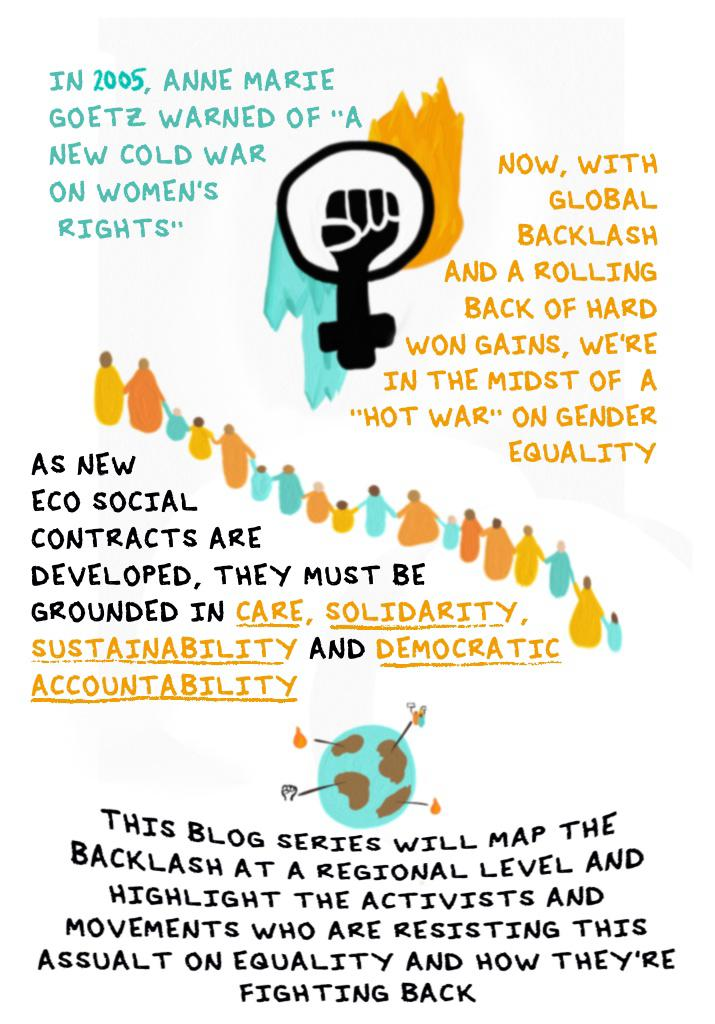
Image credit: Alex Bush
Gender Justice and the Eco-Social Contract
The Copenhagen Declaration on Social Development (1995), adopted the same year as Beijing, called for a new social contract centered on poverty eradication, full employment, and social integration. Thirty years later, the idea of a new eco-social contract is emerging from global debates as a response to converging crises such as climate change, widening inequalities, democratic erosion, and social fragmentation.
But here lies the danger, efforts to rethink and renew social contracts are taking place against the backdrop of intensifying backlash on gender rights. Without gender justice at the core, any new eco social contract risks reproducing old exclusions, reinforcing patriarchal norms, and leaving behind those already most marginalized. As UNRISD and other research has shown, eco-social contracts must be grounded in care, solidarity, sustainability, and democratic accountability. This requires recognizing the centrality of women’s labor (paid and unpaid), defending bodily autonomy, and ensuring that rights frameworks evolve to reflect intersectional realities. In other words, there can be no eco-social contract without gender justice.
Doha and the Second World Summit for Social Development
The Second World Summit for Social Development (WSSD2) held in Doha in November 2025, became a pivotal moment. It offered governments, civil society, and multilateral institutions a chance to revisit commitments made three decades earlier and articulate a renewed global vision for social development.
However, the summit unfolded at a time when gender equality had been not only undermined but directly challenged. In its Political Declaration, states acknowledged that accelerating backlash, including the resurgence of discriminatory norms, attacks on human rights defenders, and attempts to reinterpret or dilute agreed language, had threatened hard-won progress. They affirmed that gender justice was inseparable from social justice and reiterated that women’s and girls’ rights were integral to poverty eradication, inclusive development, and social cohesion. This meant -
Recognizing that organized resistance to gender equality had impeded global progress and undermined multilateral commitments.
Reaffirming obligations to uphold and implement existing international frameworks without regression.
Committing to strengthen accountability, support feminist and LGBTQIA+ defenders, and address the structural drivers of inequality.
Embedding equality, care, and rights as foundational pillars of renewed eco-social contracts.
By confronting backlash directly, the summit revived a shared commitment to place women’s rights and gender equality at the centre of global social development efforts.
From Recognition to Resistance
Thirty years post-Beijing, the challenge is not just to close gaps but to resist regression. Today, what we face is not only inertia but an organized attempt to roll back rights, requiring coordinated, intersectional, and transnational responses.
This blog series by the Gender Justice Working Group of the Global Research and Action Network for a New Eco-Social Contract (GRAN-ESC) brings together perspectives from across regions to illustrate the contours of this struggle. Together, they tell a story of both crisis and possibility - a world where rights are being stripped away, and at the same time, where new solidarities are being built.
The contributions in this series show how actors across regions are navigating these dynamics, from Latin America’s policy rollbacks and Asia’s educational bans to North America’s judicial reversals, Europe’s far-right legislation, and Africa’s overlapping crises of violence, environmental degradation, and inequality.
As these examples demonstrate, when gender is sidelined, social development stalls. Without gender justice, there can be no eco-social contract, no sustainable future, and no truly inclusive social development.