
Europe: The New Hot War on Women
This contribution is part of the GRAN-ESC blog series “The New Hot War on Women’s Rights: 30 Years Post-Beijing.” The series brings together regional and thematic reflections, some of which explore backlash while others focus more broadly on evolving gender equality debates. At the 2025 Commission on the Status of Women (CSW69), which assessed progress on the Beijing Platform for Action adopted in 1995, there was recognition of advances in areas such as girls’ education and women’s political participation, alongside acknowledgement that across most of the 12 critical areas, much remains to be achieved. In a context marked by the rise of right-wing authoritarianism, hard-won gains are also coming under renewed pressure. Through this series, the GRAN-ESC Gender Justice Working Group examines how these dynamics are playing out across different regions and actors.
At the 69th Session of the Commission on the Status of Women (CSW69), delegates observed that progress on the Beijing Platform for Action remains uneven. Despite important gains driven by feminist movements and civil society, rising right-wing populism and conservative opposition have intensified backlash against gender equality. This pushback threatens hard-won rights and highlights the urgency of protecting recent advancements and strengthening regional commitments.
Rollback of rights at a national level
In Europe, the backlash against gender equality is increasingly articulated through the language of “gender ideology,” used by both state and non-state actors to challenge feminist gains and LGBTQ+ rights as well as co-opt gender equality language for other purposes.
Italy, under Prime Minister Giorgia Meloni, illustrates the paradox of symbolic inclusion and substantive regression. While Meloni is Italy’s first woman prime minister, her administration promotes traditional family values and has supported anti-abortion groups within public health services. Italy’s CSW69 statement echoed a commitment to ‘protecting women’ but couched within a paternalistic framework that undermines bodily autonomy and the right to choose. The administration’s rhetoric often centers on protecting ‘motherhood’ while opposing what the government calls ‘gender propaganda’ in schools.
Meanwhile, Turkey’s President Recep Tayyip Erdoğan withdrew from the Istanbul Convention in 2021, claiming it promoted homosexuality and undermined family values. This move reflects the ruling AKP’s broader ideological stance, which prioritizes patriarchal norms and traditional gender roles. Legal protections for women have weakened, feminist civil society faces increased restrictions, and educational reforms emphasize conservative values while excluding comprehensive sexuality education. At CSW, Turkey has joined other conservative states in promoting “family-based approaches” and opposing inclusive definitions of gender and references to sexual orientation.
In Spain, despite its progressive legislative framework on gender equality, the far-right Vox party has spearheaded a vocal backlash against feminist policies. The party had called for the repeal of the gender violence law, claiming it discriminates against men and constitutes ‘gender totalitarianism’. The party has also attempted to dismantle regional equality bodies and slash funding for women's shelters and LGBTQ+ support programs in regions where it holds power. This anti-feminist rhetoric is often framed as a defense of ‘real equality’, a tactic used to delegitimize structural critiques of patriarchy.
Across Central Europe, Slovakia reflects a broader pattern of conservative pushback. The country has seen repeated legislative attempts to restrict abortion access, including 2020–2021 proposals for mandatory ultrasounds and waiting periods. Although these bills narrowly failed, they highlight an enduring alliance between religious institutions and conservative lawmakers, framing reproductive rights as a moral battleground rather than a matter of public health.
Similarly, in Croatia, ratification of the Istanbul Convention in 2018 provoked a nationwide conservative backlash, with mass protests falsely claiming it would impose "gender ideology" and threaten national sovereignty. In response, the government issued an interpretive declaration limiting the impact of the treaty. Since then, scrutiny of feminist NGOs has intensified, and is receiving insufficient support.
Further west, in France, the backlash manifests less through legal reforms and more through ideological appropriation. Far-right leaders such as Marine Le Pen use feminist rhetoric to justify Islamophobic policies, including hijab bans, a phenomenon described as "femonationalism". Proposed legislation targeting hijabs in sports has faced international criticism, while France’s secularism principle, laïcité, is increasingly employed to control women’s bodies rather than advance gender rights.
Meanwhile, Hungary has become a key player in formalizing conservative gender norms. A signatory of the Geneva Consensus Declaration, it supports traditional family roles and denies the existence of an international right to abortion. In 2025, Hungary passed laws banning LGBTQ+ public events and enforcing a binary definition of gender under the guise of protecting children. A proposed “transparency” bill targeting foreign-funded NGOs has also drawn criticism for threatening media freedom and civil society, especially organizations advocating for gender equality.
In Poland, the election of a new coalition government under Donald Tusk in 2023 marked a potential turning point after years of rollback under the Law and Justice (PiS) party. However, internal disagreements have stalled progress on key reforms, including comprehensive sex education, protections for LGBTQ+ students, and the liberalization of strict abortion laws. This cautious approach underscores the ongoing tension between popular mandates for change and political will.
Recently, across the UK, anti-immigrant protests have surged, with far-right groups increasingly co-opting the language of Violence Against Women and Girls (VAWG) to scapegoat asylum seekers. Demonstrations outside asylum accommodation, such as The Bell Hotel in Epping, have featured slogans like “Protect our women and children” and “Stop assaults.” Over 100 women’s rights and anti-VAWG organizations, including Rape Crisis England & Wales and the End Violence Against Women Coalition, signed a public letter warning that such rhetoric dangerously exploits the issue of gendered violence to fuel xenophobia and distract from the structural causes of violence. Similarly, prominent UK women leaders have urged right-wing politicians, including Nigel Farage and Robert Jenrick, to stop linking asylum seekers with sexual abuse, emphasizing that this narrative manipulation stokes fear without evidence.
Finally, Women Against Violence in Europe (WAVE), a feminist network representing over 1,600 women’s organizations across Europe, has expressed concern about the alarming shrinking space for feminist civil society and women human rights defenders. Members across Europe have reported increasingly hostile and unsustainable conditions, from political repression and legal threats to chronic underfunding and exclusion from policymaking.
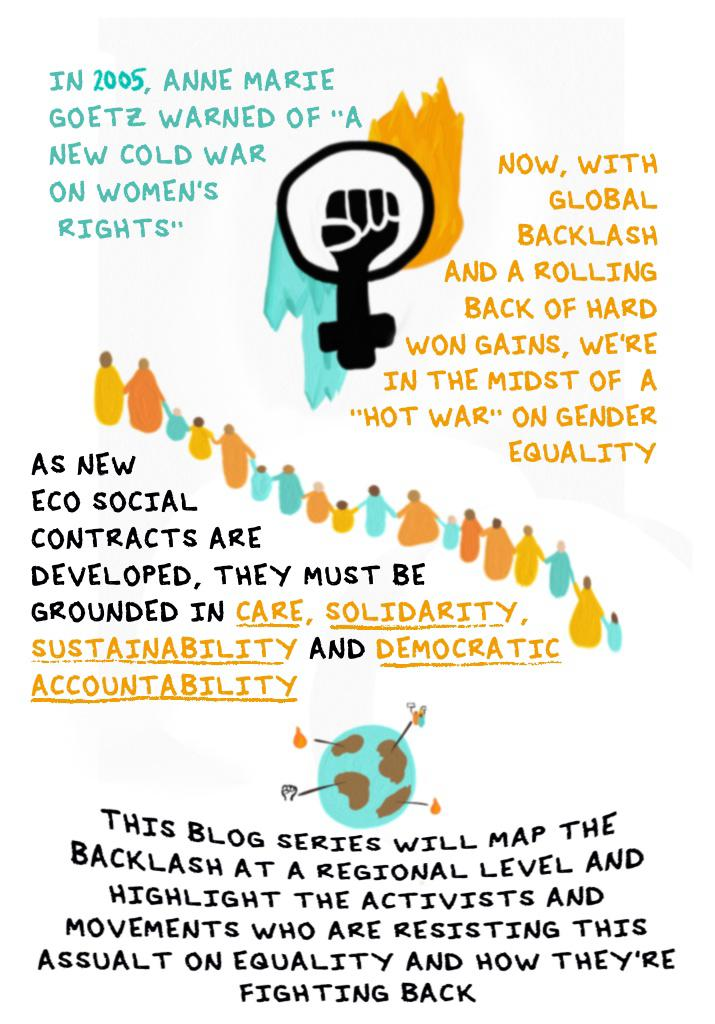
Image credit: Alex Bush
Grassroots resistance
These developments illustrate the complexities and challenges in advancing gender equality amidst rising conservative and authoritarian political actors coordinating against gender ideology. However, there have been some limited achievements.
Across Europe, grassroots gender movements and civil society organizations have played a vital role in pushing forward progressive change. From feminist networks to youth-led campaigns, these movements have mobilized communities, shaped policy debates, and secured legal reforms that strengthen protections for women and girls. One notable example is the EU’s first-ever binding law on violence against women and domestic violence, adopted in 2024 after years of pressure from civil society. The directive not only criminalizes forms of online and offline abuse but also mandates stronger victim support and justice mechanisms, demonstrating how activism and advocacy can translate into concrete protections.
At the same time, regional initiatives highlight how activism is reshaping institutions from within. For instance, pioneering legislation in Catalonia now recognizes violence against women in politics, addressing harassment and intimidation in public life. Networks such as Women Against Violence Europe (WAVE) and their youth ambassadors have also been instrumental in raising awareness, promoting education, and challenging persistent stereotypes. These young activists, supported by broader feminist coalitions, represent a new generation of voices determined to normalize inclusive public discourse and to ensure that gender equality is not sidelined in political or cultural debates.
These achievements demonstrate that progress is not only achieved through legislation but also through the resilience of Europe’s gender equality movements. By joining forces, whether through pan-European advocacy campaigns, grassroots mobilization, or strategic partnerships with institutions, civil society continues to build momentum for equality. Despite the rise of anti-gender narratives, the collective efforts of activists, youth, and NGOs are ensuring that Europe remains in a region where hard-won rights are defended and expanded, at the same time as other rights are being rolled back.