
Gender Equality and Backlash in Latin America & the Caribbean
This contribution is part of the GRAN-ESC blog series “The New Hot War on Women’s Rights: 30 Years Post-Beijing.” The series brings together regional and thematic reflections, some of which explore backlash while others focus more broadly on evolving gender equality debates. At the 2025 Commission on the Status of Women (CSW69), which assessed progress on the Beijing Platform for Action adopted in 1995, there was recognition of advances in areas such as girls’ education and women’s political participation, alongside acknowledgement that across most of the 12 critical areas, much remains to be achieved. In a context marked by the rise of right-wing authoritarianism, hard-won gains are also coming under renewed pressure. Through this series, the GRAN-ESC Gender Justice Working Group examines how these dynamics are playing out across different regions and actors.
"The 69th Commission on the Status of Women: Not as Bad as Some Predicted, " which summarizes this year’s summit in the context of an aggressive and expansive gender backlash across the global stage, is a fitting assessment for the Latin America and the Caribbean region. This blog will present the gains made by women over the last half century, even as the far right expands in Latin America, and highlights policy progress and growing political will among Caribbean nations to address gender inequality.
Regional backsliding on gender equality
The election of Jair Bolsonaro as president of Brazil in 2018 is often cited as the starting point for the consolidation of the “new right” in Latin America and the resulting increase in large-scale backlash and backsliding of women’s rights in the region. However, it is important to acknowledge that Bolsonaro was building on pre-existing efforts, for example adding to more than 200 legislative proposals to ban “indoctrination and gender ideology” that were introduced from 2014 to 2022, mostly at the local level. Building on this foundation, an enforcement and surveillance mechanism was created through the Ministry of Women, Family, and Human Rights (MMFDH), while services addressing gender violence, workplace discrimination, maternal deaths and other inequalities became increasingly underfunded.
The return of the left-wing Workers’ Party and Luis Inácio Lula da Silva to the executive in the 2022 general elections did little to stop scenarios like this from becoming increasingly common at a regional level. Similar political landscapes have appeared in recent years across Latin America in countries like Argentina and El Salvador. Common drivers for this include persistent insecurity and violence, a high degree of economic uncertainty, disillusionment in democratic institutions, and a sense of conservative values being under siege. As a result, the justifications given for the erosion of women’s rights in these countries have been framed in a blend of libertarian, authoritarian, and “anti-woke” reasoning.
Javier Milei, for example, since becoming president of Argentina in 2023, has eliminated both the Women’s Ministry and the National Institute against Discrimination, Xenophobia and Racism (INADI), arguing that these were “militant and politicized” institutions. On the other hand, these actions were also framed as part of the efforts to create a “lean and effective” State apparatus. The underfunding of measures for ensuring the right to an abortion was defended on similar grounds, leading to misoprostol and mifepristone deliveries dropping from 106,737 to zero between 2023 and 2024. This is representative of a generalized collapse of resources for programs with strong gender components like addressing reproductive health, salary gaps, gender violence, care services, etc.
Likewise, in El Salvador, Nayib Bukele’s administration has completely banned gender related topics from public schools, defunded the Salvadoran Institute for Women’s Development (ISDEMU), and dissolved the General Directorate for Statistics and Census (DIGESTYC), which among other institutes, kept the most up-to-date data on gender-based violence. On top of this, aggressive policies made incarcerated women vulnerable and susceptible to intimidation and violence, in which acts of aggression are conducted by military police. This comes on top of increased economic burdens for women in the absence of their imprisoned partners.
Meanwhile, in Ecuador, the recent electoral victory of Daniel Noboa in 2025 has seen yet another Women’s Ministry go up in smoke, amid large-scale cuts to public spending in the country, which has already led to the dissolution of six out of twenty previously existing ministries.
It is notable that the latest swing towards right-wing governance happens after consistent victories for gender equality in Latin America, whose positive effects are still felt even in the context of this widespread rollback on rights. The World Economic Forum’s 2025 Global Gender Gap Report, for example, shows Latin America and the Caribbean “leading the regional scoreboard” only below North America and Europe. This is driven mainly by progress on educational and health-related outcomes. However, when it comes to economic participation and especially political empowerment, the disparities remain wide and glaring.
In terms of economic participation, variations between and within countries seem to be a major component in explaining the overall shortcomings at the regional level. For example, while the proportion of women joining the workforce has drastically increased in countries like Chile, it has either stalled or regressed in countries such as Colombia or Honduras. In the same vein, drastic differences among women based on education and income levels are still prevalent. These inequalities continue to shape women access to the workforce are still.
With regards to women’s representation in political decision-making, slow progress may be attributed to delayed introduction of gender quotas, with Argentina bringing in the first legislation in the region as late as 1991. Today, nine countries — Ecuador, Bolivia, Costa Rica, Nicaragua, Panama, México, Honduras, Argentina, and Perú — have gone beyond quotas to develop and implement gender parity legislation. As a result, by 2022, around 35% of lawmakers and 29% of heads of ministries in Latin America and the Caribbean were women.
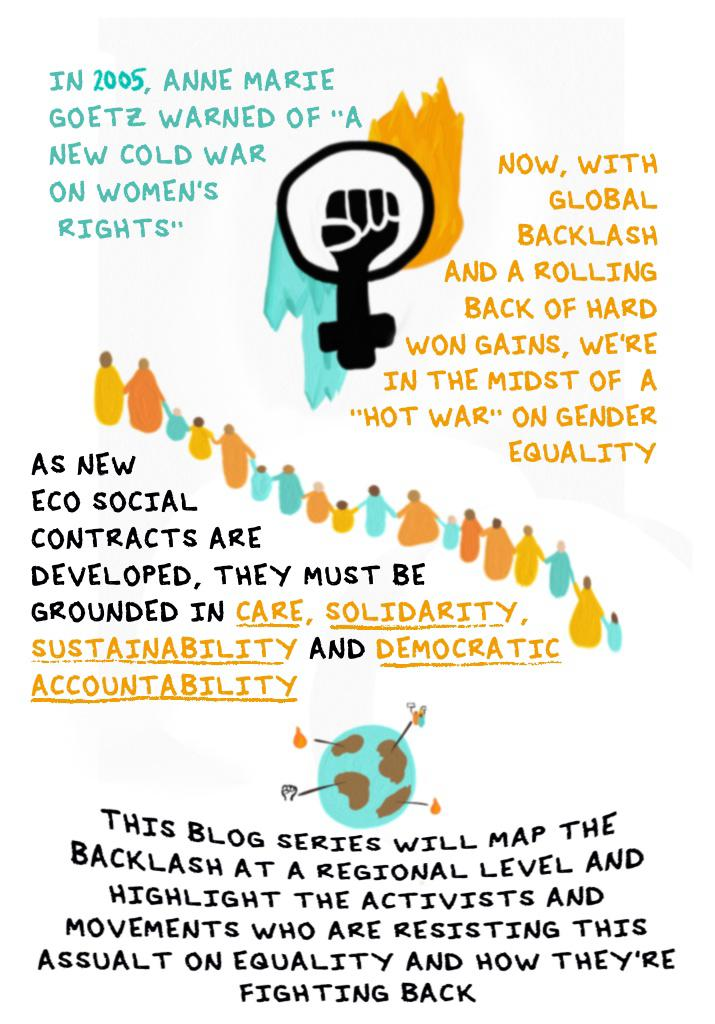
Image credit: Alex Bush
This imperfect progress has been upheld mostly by the region’s feminist movements, which have mobilized and built coalitions to counter the new Latin American far right’s advance, filling the vacuum left by the continuous dismantling of the State. These movements have also increasingly reaffirmed the transformational approach of Latin American feminisms in demanding more than inclusion in existing political and economic systems. This is particularly relevant given that, although still very much understudied, women have also been fundamental agents in the consolidation of the far right in the region.
One example of transformative approaches entering the political mainstream was the sixteenth session of the Regional Conference on Women in Latin America and the Caribbean in Mexico City, which led to the publication of the United Nations Economic Commission for Latin America and the Caribbean’s (CEPAL) report on the “care society”. This represented a paradigm shift in positioning care as a lifelong necessity and a public good. However, continuous pressure will be required to guarantee the materialization of the text.
In the Caribbean, on the other hand, gender equality is typically seen not as an ideology, but a shared policy aim, especially where democratic backsliding is much more limited. For example, a June 2025 joint communique between the Caribbean and Brazil highlights women’s vital role in society and economic activities such as farming and further recognizes that climate change’s disproportionate impact on women. This view is aligned with the United Nations’ sustainable development goals and expressed by many environmentally conscious nations, especially the Small Island Developing States.
In Cuba, although women have guaranteed political rights and enjoy overrepresentation in higher education, cultural norms persist that disengage women from competitive markets. Women face additional challenges in manufacturing and business ownership, for example, with less than a quarter of women are self-employed and carry a business license. This is for a country that underperforms economically. Women also continue to face restrictions on holding land.
Women, Peace, and Security (WPS) play a huge thematic role throughout the Caribbean. As the International Community continues to engage in debates concerning its progress on WPS, Trinidad and Tobago has introduced a new plan to strengthen its commitments under the WPS agenda. The country has historically struggled with violence linked to gang warfare and domestic abuse, and it has made important strides by aligning with UN Security Council Resolution 1325 and approaching crime as a public health issue. At the same time, women remain underrepresented in talks concerning climate.
The Dominican Republic is exemplary in its role of increasing stability and the legal foundation for women’s independence, for example, through education. However, gaps are still present due to cultural norms and the lack of equality in economic decision-making. These gaps have cost the Dominican Republic about 2.2% of its GDP in 2022. This loss of human capital is also harmful as the Dominican Republic is like its other Caribbean neighbours, particularly susceptible to climate change.
Dominican Republic has experienced gendered environmental impacts and is an example of the direct impacts of climate change on its indigenous community. Dominicam Republic’s economy is not climate resilient, as it relies on the land for its livelihood. Poverty is often gender-based, as is violence. Women are more likely to face unemployment and pay gaps. Despite these challenges, Dominica’s women are educated and well represented in politics. As for the Kalinago Indigenous community, they are underrepresented in politics and often excluded from decision-making, particularly women.
Saint Lucia, on the other hand, is an example of female political leadership in the face of persistent challenges, even as law enforcement remains male dominated. Despite their representation as managers and social developers, cultural norms continue to undermine women’s legitimacy as leaders. In female dominated industries, men face smaller wage gaps compared to their female counterparts, while in male dominated industries, women face larger wage gaps. Age also affects women’s wages, whereas it does not affect men’s wages. Education increases women’s earnings only at higher levels, while education at any level plays has no effect on men’s wages. This reflects not only imbalances in wage policy, but also deeper disparities in knowledge sharing. It is clear that knowledge sharing drives immediate action to address climate change as well as social change and development. Effective change therefore requires sharing not only knowledge but also power and enforcement capacity.
While Latin America shies away from institutionalization, the Caribbean continues to embrace it. Despite difficult and often antagonistic contexts, advocates for gender equality and women’s rights have managed to preserve several gains and secure some new ones across Latin America and the Caribbean. A small refinement of the introductory “not as bad as we feared” assessment may be needed. A more accurate version might be “not as bad as we fear … if we act”.