
Patterns for Parity
Updated: Dec 4, 2025
This contribution is part of the GRAN-ESC blog series 'The New Hot War on Women’s Rights: 30 Years Post-Beijing.' The series brings together regional and thematic reflections, some of which explore backlash while others focus more broadly on evolving gender equality debates. At the 2025 Commission on the Status of Women (CSW69), which assessed progress on the Beijing Platform for Action adopted in 1995, there was recognition of advances in areas such as girls’ education and women’s political participation, alongside acknowledgement that across most of the 12 critical areas, much remains to be achieved. In a context marked by the rise of right-wing authoritarianism, hard-won gains are also coming under renewed pressure. Through this series, the GRAN-ESC Gender Justice Working Group examines how these dynamics are playing out across different regions and actors.
Across every region reviewed under this blog series, the rollback on women’s and gender minorities’ rights is justified through the language of 'tradition,' 'protection,' and anti-'gender ideology'. However, this backlash does not affect all women or gender minorities equally. Those living at the intersections of disability, race, class, migration status, and sexuality, in other words the 'multiply marginalized', face compounded, often invisible harms as support structures weaken or are defunded, surveillance intensifies, and public discourse narrows around essentialist, ableist, or nationalist paradigms.
This piece offers an intersectional synthesis that highlights disability justice and the framework of intersectionality, emphasizing the urgent need to move beyond isolated approaches towards deeply participatory, transdisciplinary action.
A disability justice perspective, grounded in the social model of disability, highlights societal and institutional barriers rather than individual 'deficits.' Policies aimed at gender rights often unintentionally create more disabling barriers: inaccessible or insufficiently funded services, legal rollbacks, surveillance, or criminalization. These effects are exacerbated for disabled women and girls and gender non-conforming people (including those who menstruate), especially when compounded by racism, anti-migrant attitudes, anti-LGBTQI+ rhetoric, or economic marginalisation. However, these intersectional harms are often overlooked or insufficiently addressed, leading to data erasure and limiting policy responses.
Latin America exemplifies these patterns. The closure of the Women’s Ministry and INADI in Argentina, along with the defunding of gender-based services and data in El Salvador, has serious consequences for disabled women, Black and Indigenous groups, and single mothers, who rely on accessible public care, violence support, and credible data for advocacy. The removal of data infrastructure, such as the dissolution of DIGESTYC, increases invisibility and further excludes those already marginalized from accountability processes. The impact is structural: women with disabilities or intersecting identities, who are already facing workplace discrimination or violence, are most vulnerable to resource withdrawal, policy vacuum, and institutional collapse.
Asia’s analysis highlights this ongoing issue, particularly regarding institutionalized exclusion. Taliban policies banning girls from education have devastating consequences, but the impact of exclusion on disabled girls is not just additive, it is exponential, as access to community-based learning, healthcare, and protection mechanisms diminishes. The Rohingya situation mirrors this: barriers for refugee girls with disabilities intersect with language, poverty, and statelessness, so measures restricting or monitoring gendered behaviour heighten the risk of exploitation or violence, with limited options for recourse. Across Asia, regressive policies on dress codes (India’s hijab ban) and anti-feminist rhetoric (South Korea, China) systematically deny the rights and realities of those who are multiply marginalized through disability and other statuses.
In North America, the declared commitment to intersectionality in Canadian policy is undermined by material cuts, such as the removal of the Minister of Women and Gender Equality and detention measures affecting migrant populations. For disabled, Black, Indigenous, and 2SLGBTQI+ women and girls, these policy retrenchments manifest as rising inequalities in housing and healthcare, diminishing legal protections, and further erosion of rights. In the U.S., the intersection of reproductive justice rollbacks, anti-trans legislation, and the erosion of affirmative action converges with ableist public policies, creating a multi-layered crisis for BIPOC and disabled people at the gender margins.
Europe, often viewed as the region most aligned with progressive institutional frameworks, is not immune. Its backlash frequently disguises itself as 'protection' while employing 'gender ideology' rhetoric, as seen in Hungary and Italy. Disabled migrant women facing abortion restrictions, anti-hijab measures, or welfare cuts encounter deep-rooted barriers to healthcare, education, and civic participation. The targeting of civil society (Hungary’s anti-NGO bills) and data infrastructure (such as in Croatia) worsens the exclusion of marginalized communities from democratic participation and legal redress. The misuse of feminist language by right-wing actors in France demonstrates how 'inclusion' can be exploited to promote exclusion when intersectionality is overlooked and stereotypes or norms are used to police minoritized bodies.
These cross-regional themes illustrate that gendered regression is linked to rising ableism, racism, and exclusionary nationalism. As Crenshaw’s concept of intersectionality explains, focusing only on individual axes such as gender, race, or disability does not address how systems interconnect and create unique marginalisations. It is vital to recognise, for example, that laws and practices limiting reproductive justice, access to justice, or education for 'all women' can, if not carefully considered, exclude those whose bodies, minds, and circumstances do not fit the dominant narrative or who are already shut out from public or civic engagement.
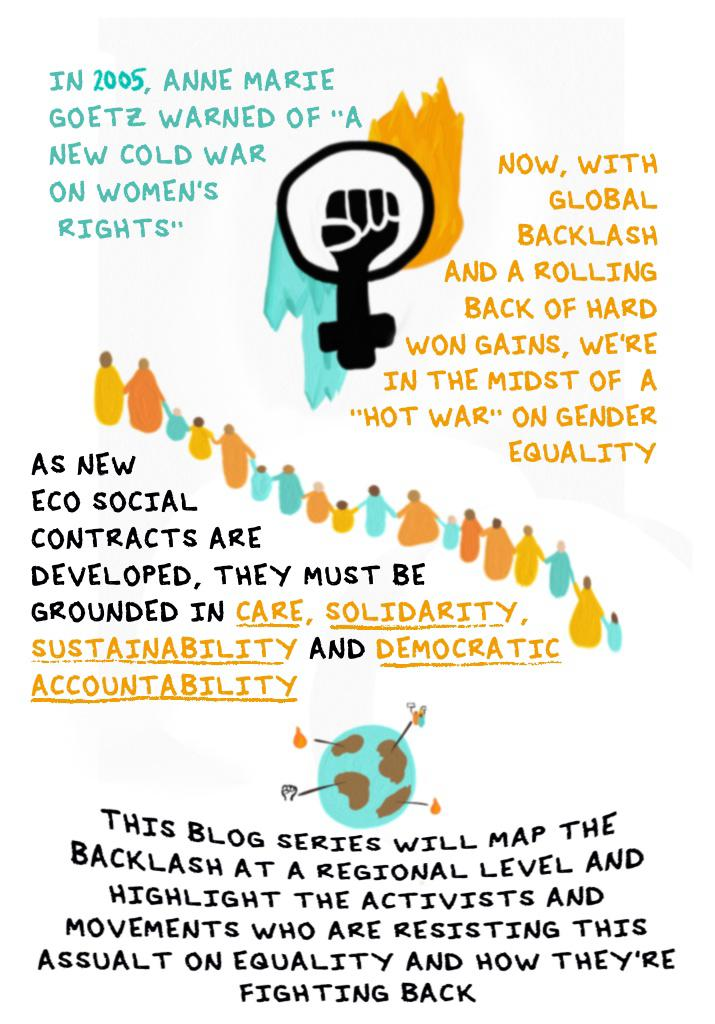
Image credit: Alex Bush
To move towards transformative, equitable futures in the coming decades, several recommendations emerge:
Accountability with affected leadership: International, national, and regional bodies must embed accountability mechanisms that are co-led by disabled, racialised, migrant, and LGBTQI+ women and girls, not just include them. Monitoring, resource allocation, and policy evaluation must start with those at the intersectional margins.
Transdisciplinary and cross-sector coalitions: Addressing deeply embedded, interconnected oppressions require collaboration across sectors such as health, social care, disability, education, migrant justice, and climate. This approach enables holistic identification and removal of disabling barriers, rather than merely applying technical fixes or isolated interventions.
Data justice and the end of erasure: The removal or underfunding of gendered and disability data infrastructure is not accidental; it is structural. Rigorous, intersectional data collection (including disability, race, migration status, and sexuality) is essential for measuring impact, demanding accountability, and developing precise remedies.
Legal harmonisation and enforceability: Laws must explicitly address intersectional exclusion and align with enforceable rights mechanisms, such as the UN Convention on the Rights of Persons with Disabilities (CRPD), CEDAW, and the Belém do Pará Convention. Local implementation must be monitored for genuine accessibility, not merely formal compliance.
Inclusive civic education and narrative change: Investing in lifelong, accessible education, both formal and informal, can shift narratives from essentialist or protectionist views to pluralist, justice-centred frameworks. Amplifying the stories and expertise of marginalized groups can counteract discursive erasure.
Resourcing intersectional movements: Grassroots, feminist disability, and migrant-led movements must receive sustained, core, not project-based, resources, not only to respond to rollbacks but also to innovate, envision, and architect fairer collective futures.
Crucially, it is only through these interconnected, participatory strategies, grounded in the lived expertise of those at the most critical intersections, that global actors can counter authoritarian regression and promote a genuinely inclusive, rights-based path for the next thirty years. Continuing with gender-only or 'non-disabled universal' approaches will sustain exclusion and weaken the principles outlined in Beijing and now reflected in the SDG and CRPD frameworks.