
The New Hot War on Women in North America (United States and Canada)
Updated: Dec 4, 2025
This contribution is part of the GRAN-ESC blog series “The New Hot War on Women’s Rights: 30 Years Post-Beijing.” The series brings together regional and thematic reflections, some of which explore backlash while others focus more broadly on evolving gender equality debates. At the 2025 Commission on the Status of Women (CSW69), which assessed progress on the Beijing Platform for Action adopted in 1995, there was recognition of advances in areas such as girls’ education and women’s political participation, alongside acknowledgement that across most of the 12 critical areas, much remains to be achieved. In a context marked by the rise of right-wing authoritarianism, hard-won gains are also coming under renewed pressure. Through this series, the GRAN-ESC Gender Justice Working Group examines how these dynamics are playing out across different regions and actors.
Globally, there has been an increasing backlash against gender justice. A recent report analyzes how right-wing authoritarian political actors weaponize opposition to “gender ideology” (defined as a catch-all term that refers to any policies or movements related to women’s rights and LGBTQ+ rights) to create a broad base of support among groups with otherwise conflicting political beliefs to advance authoritarianism and erode institutional protections and commitments to human rights and social justice (Othering & Belonging Institute). This movement positions gender justice as an “enemy” of national security, social life, and families. It uses fear-mongering tactics to spread misinformation about historically marginalized groups, and leverages narratives of “protecting women and children” to justify state surveillance and violence against queer and trans people, women, immigrants, and people of color. Using these strategies, authoritarian populist movements and activists attempt to both legitimize and build widespread support for attacks on gender-based rights while also promoting white supremacy, ableism, and economic injustice.
The United States has been and continues to be one of the most vocal opponents of “gender ideology,” expressed as persistent legislative attacks on trans people’s rights and gender affirming healthcare, threats to marriage equality, the dismantling of DEI (Diversity, Equity, and Inclusion) initiatives, and continued violations of reproductive rights. In 2022, the US overturned the ruling in landmark Supreme Court case Roe v. Wade, eroding legal protections for reproductive healthcare across the country and creating major challenges to gender-based healthcare. Currently, 13 states have total legal bans on abortion in effect.
Additionally, this year, the United States has removed itself from the Commission on the Status of Women (CSW). In a statement on March 10, the United States defined “women’s rights” using biological essentialism and promoted racist anti-immigration policies framed through the language of “curbing mass migration and securing borders.” As is the case in other states where gender-based rights are under attack, violations of gender-based rights in the United States coincide with violations of racial and economic justice, as illustrated by the attacks on affirmative action programs in higher education, persistent racial disparities in maternal health outcomes, and disproportionate state violence committed against Black women and trans women of color. These attacks occur in a landscape where women already experience disproportionately high rates of poverty, with women of color, disabled women, and trans people being overrepresented among those living in poverty in the US.
In contrast, Canada’s statement to the CSW emphasized the global attacks on gender-based rights and acknowledged the intersectional nature of gender-based rights, noting the disproportionate impact that such violations have on Black, Indigenous, and 2SLGBTQI+ (Two- Spirit, Lesbian, Gay, Bisexual, Transgender, Queer, Intersex, and plus) people. Further, it highlighted increasing resources to expand affordable housing, employment opportunities, and affordable childcare. The country also recently ratified the Belém do Pará Convention, which addresses gender-based violence. On International Women’s Day this past March, the Chief of the Human Rights Commission, the interim Pay Equity Commissioner, the Federal Housing Advocate, and interim Accessibility Commissioner issued a joint statement on the status of women in Canada, noting the persistence of gender-based violence in Canada and that women with disabilities in Canada continue to face disproportionate rates of homelessness as a result of violence.
However, the domestic record is more mixed. Prime Minister Mark Carney has eliminated the Minister for Women and Gender Equality post, and Ontario’s use of provincial jails to detain asylum seekers has drawn significant criticism. Violence against trans people in Canada has also been increasing, with increased anti-trans legislation at the federal level and heightened risks for trans people across the provinces. In addition, an estimated 80% budget cut was recently announced to Canada’s Department for Women and Gender Equality (WAGE), posing major threats to gender justice organizations across Canada working on issues of gender-based rights as well as racial and economic justice. These budget cuts will also erode WAGE’s impact on enacting gender equality programming and initiatives at the national level.
These developments reflect the contradictions at the heart of North America’s gender politics: rhetorical commitment coexisting with policy retrenchment.
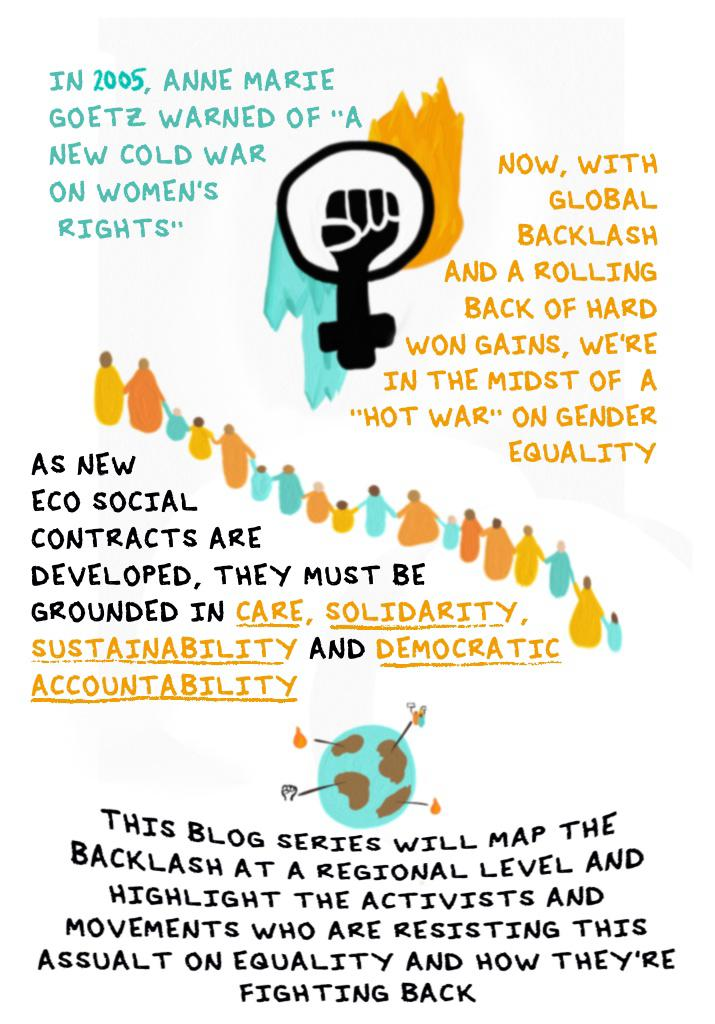
Image credit: Alex Bush
Moving forward, continued coalition-building at the local level, across immigration, racial justice, labor rights, disability, and gender movements will be essential to counter coordinated rollback efforts.
In the United States, local and state level grassroots movements, advocacy, and innovative policymaking have been important forms of resistance against these injustices. Grassroots movements and legal aid organizations have resisted attacks on gender justice using intersectional organizing frameworks, advocacy to local policymakers and elected officials, and community organizing tactics to enact change. For example, community abortion funds have been instrumental in addressing barriers to abortion care, particularly for people in states with near total or total abortion bans. Abortion funds in the United States have seen significant increases in both fund requests and in donations, providing life-saving resources to people in states where abortion care is criminalized and/or inconsistently available.
Given the onslaught of legislative threats to gender justice, legal aid organizations working at the intersections of multiple social issues have made important gains at the state and (in some cases) the federal level in advocating legal protections. For example, the Transgender Law Center has filed a lawsuit in collaboration with the ACLU and other US-based human rights organizations against the Trump administration and the Bureau of Prisons for denying gender affirming care to people who are currently incarcerated. Likewise, Chicago Women in Trades (CWIT), a Chicago based non-profit training program supporting women pursuing trade professions, successfully sued and won a temporary preliminary injunction that prevented the immediate termination of federal funding for the organization's programming. While legal protections are only a small part of promoting and protecting gender-based rights, these cases highlight vital coalition-building work taking place on the ground to combat gender-based rights violations.
State level policymaking has also been an important strategy. For example, Illinois recently passed a bill enshrining protections against discrimination based on reproductive decision-making and extending the Illinois Human Rights Act. This bill has meaningful implications for those seeking abortion care and for historically marginalized people, such as single people and same-sex couples, seeking fertility care. Similarly, as a result of a coalition of reproductive justice organizations working across states in the New England region, Massachusetts recently passed legislation that increases funding support to early childcare services, maternal healthcare, increased legal support for LGBTQIA+ parents pursuing legal parentage rights, and increased economic resources supporting reproductive healthcare access across the state.
Grassroots collectives have always been at the forefront of gender justice activism in the United States, historically working at the intersections of addressing systemic racism, state violence, gendered oppression, and economic injustice. For example, Dream Defenders is a grassroots racial justice organization that was formed in response to anti-Black police violence in the US. Founded on principles of prison abolition, anti-imperialism, and Black feminism, Dream Defenders runs trainings on community organizing, creates public educational resources on racial injustices across the US, and develops campaigns in support of racial justice initiatives across the US. Additionally, SisterSong Women of Color Reproductive Justice Collective is a feminist collective and a leading human rights organization in the US promoting reproductive justice and combatting racism and anti-Blackness, and United We Dream centers queer and trans feminist of color voices in their organizing strategy protecting immigrants’ rights in the US.
Similarly, in Canada, grassroots movements and provincial and local policy advocacy have been meaningful forms of resistance against gendered oppression. For example, the Women’s Legal Education and Action Fund (LEAF) is a legal advocacy and public education organization with active chapters throughout Canada that has promoted gender justice through intersectional initiatives, such as advocacy for stronger collective bargaining rights for unions, reducing poverty for people with disabilities, increasing legal pathways to justice for people who have experienced gender-based violence, and advocating for legal protections for reproductive rights in Canada. Further, LEAF has championed public education and legal advocacy initiatives with specific emphasis on combatting the gendered and racialized oppression of Indigenous women and trans women in Canada. LEAF is also currently running a project focused on identifying barriers to valuing care work in Canada and developing a policy strategy to address inequities faced by care workers, which disproportionately impact women. Recently, LEAF, as a part of a coalition of gender justice organizations, effectively challenged a law in Saskatchewan that would require parental consent for educators and school officials to be able to use the preferred name and pronouns of children under the age of 16. Other organizations such as Justice Trans have developed ways of information sharing, researching and public educational content about the rights of 2S/TNBGD (Two-Spirit/ Trans, Non-Binary, and Gender Diverse) people in Canada.
Another key example is the Native Women’s Association of Canada, founded to address discrimination against Indigenous women and has been an important voice in advocating for policies and legislation supporting the rights of Indigenous WG2STGD+ (Women, Girls, Two-Spirit, Trans, and Gender Diverse) people in Canada. The Canadian Research Institute for the Advancement of Women (CRIAW), on the other hand, works in collaboration with feminist organizations across Canada to develop research and legislative strategies that advance protections for gender-based rights, and the Disabled Women’s Network of Canada (DAWN) employs an intersectional human rights framework to promote gender justice and disability rights in Canada through education, policies, and community building initiatives. Similar to state level resistance against gendered oppression in the US, provincial level advocacy and organization have been important sites of advocacy for gender-based rights in Canada.
While their positions around gender rights differ on the global stage, both the United States and Canada face increased austerity measures and institutional attacks on gender-based rights, happening in conjunction with attacks on racial minorities, immigrants, disabled people, and poor and working-class communities. As the systematic dismantling of key public resources such as healthcare, social welfare, education, and DEI programs continues, it is increasingly important for movements and advocacy organizations at every level of society to place gender justice at the center of their strategies for advancing human rights. In addition to continued organizing at the grassroots level and influencing policymakers at the local and state level, continued coalition-building is needed to fight rising authoritarianism and resist gender-based oppression.