
Resisting the Backlash: Gender Justice in Asia Amid Authoritarian Pushback Post-CSW69
Updated: Dec 4, 2025
This contribution is part of the GRAN-ESC blog series “The New Hot War on Women’s Rights: 30 Years Post-Beijing.” The series brings together regional and thematic reflections, some of which explore backlash while others focus more broadly on evolving gender equality debates. At the 2025 Commission on the Status of Women (CSW69), which assessed progress on the Beijing Platform for Action adopted in 1995, there was recognition of advances in areas such as girls’ education and women’s political participation, alongside acknowledgement that across most of the 12 critical areas, much remains to be achieved. In a context marked by the rise of right-wing authoritarianism, hard-won gains are also coming under renewed pressure. Through this series, the GRAN-ESC Gender Justice Working Group examines how these dynamics are playing out across different regions and actors.
Asia is no exception to the global rise in backlash, where political and social resistance threatens the rights of women and gender minorities. This blog examines how such backlash is articulated in CSW political statements and regional discourses, particularly in contexts shaped by conservative and right-wing narratives. It also considers strategies for accountability and renewed commitment to the Beijing Platform.
The authoritarian turn in Asia and the gender backlash
Over the past decade, several Asian nations have witnessed a slide into illiberalism, marked by authoritarian governments, hyper nationalist narratives, and shrinking civic space. This political context has emboldened conservative actors to frame gender rights related to sexual orientation, gender identity and expression, reproductive rights, and comprehensive sexuality education as threats to traditional values, national sovereignty, or cultural identity.
In countries like Indonesia, Malaysia, India, and the Philippines, public statements by state representatives and influential non-state actors at CSW69 and other global spaces reveal increasing discomfort with the perceived imposition of "Western gender norms." This often manifests in a rejection of terms like “gender identity,” “LGBTQ+ rights,” or “gender ideology,” which are framed as foreign, ideological, or anti-family.
Understanding language of the backlash
Right-wing authoritarianism in several Asian countries is leading to a troubling regression from the progress made in gender equality, as reflected in various policies that undermine women’s rights and political participation. The examples below highlight how this shift is being borne out in policy and dominant narratives:
In Afghanistan, the Taliban’s ban on girls’ education beyond sixth grade is affecting over 1 million girls and contributing to significant economic setbacks.
In Bangladesh, restrictions on Rohingya refugees, particularly the exclusion of girls from schools outside refugee camps, heighten their vulnerability to forced marriage and other gender-based violence.
In Japan, the Prime Minister’s appointment of only two women to his 20-member cabinet, down from five, signals a retreat in female political representation despite the ruling party’s pledge to increase the share of female lawmakers to 30% over the next decade, well below the G7 average.
In South Korea, former President Yoon Suk-Yeol has further polarized the political climate with anti-feminist rhetoric, including calls to abolish the Ministry of Gender Equality and accusations that feminism is the cause of low birth rates, impeding women’s political progress.
In China, although legal frameworks like the 2023 revision of the Women’s Rights and Interests Protection Law aim to protect women’s rights, challenges persist in implementation, and issues like domestic violence remain pervasive, exacerbated by the 2021 Civil Code’s controversial "cooling-off period" for divorce applications. At the National Women’s Congress in Beijing in November 2023, President Xi Jinping instructed female attendees to exit the workforce, return home, get married, and bear children. Moreover, in 2023, no women were appointed to the Politburo, and state media campaigns reinforced traditional gender roles, emphasizing domestic responsibilities.
India’s official statement at CSW69 highlighted gender equality initiatives such as the Beti Bachao Beti Padhao campaign and increasing female political participation. However, references to intersectionality, sexual rights, or the challenges faced by trans and non-binary persons were conspicuously absent. At the same time, the state of Karnataka’s 2022 ban on hijabs in schools excluded Muslim girls from classrooms, sparking protests over religious freedom and gender discrimination, while the 2023 Women’s Reservation Bill, aimed at reserving 33% of seats for women in parliament, has yet to be implemented. These developments reflect a broader trend of regression in the fight for gender equality in the region.
The Indonesian delegation at CSW69 reaffirmed its commitment to gender equality but notably avoided explicit references to SOGIESC (sexual orientation, gender identity and expression, and sex characteristics) or reproductive rights. Domestically, gender rights are often reframed through a family-oriented lens, emphasizing women's roles as mothers and caregivers. Moreover, “Indonesia Tanpa Feminis” which translates to "Indonesia Without Feminism, is a backlash movement that frames feminism as a Western import conflicting with Islamic values. The recent passage of the "Criminal Code" in 2022, which includes provisions that can criminalize consensual same-sex relations and extramarital sex, is evidence of legal rollback.
Malaysia's statement at CSW69 emphasized Islamic values, stressing the importance of national context in implementing gender-related policies. This is consistent with domestic policies that have curtailed LGBTQ+ rights and led to a rise in state-sponsored “rehabilitation” programs targeting gender non-conforming individuals. As in other countries, here political discourse uses “gender ideology” as a rallying cry for moral panic and nationalist protectionism.
The Philippines, once a leader in gender-sensitive legislation, has witnessed increasing tension between progressive civil society and conservative religious groups. Although its CSW69 statement upheld commitments to gender equality, strong lobbying by religious actors continues to block the passage of comprehensive sexuality education and the SOGIE Equality Bill. Instead, the Duterte and Marcos administrations have favoured vague family-centric rhetoric while diluting institutional support for feminist organizations.
Pakistan’s CSW69 statement reaffirmed women's empowerment within the framework of Islamic values, but it sidestepped contentious issues like marital rape, forced conversion, and transgender rights. The anti-trans backlash in 2023, which led to proposed amendments weakening the landmark 2018 Transgender Persons (Protection of Rights) Act and achievement of self-identity as ‘third gender’ after years of struggle and stigmatization reflects how political and religious alliances are increasingly targeting vulnerable gender minorities. The country witnessed backlash to Pakistan’s Aurat March, moral panic over slogans like 'Mera Jism Meri Marzi,' threats to participants, resolutions against the event, and allegations of violation of traditional values
On the other hand, in Thailand, authoritarian educational policies enforcing strict dress codes and hairstyle regulations for girls were partially overturned in 2025, marking a shift toward greater individual freedom.
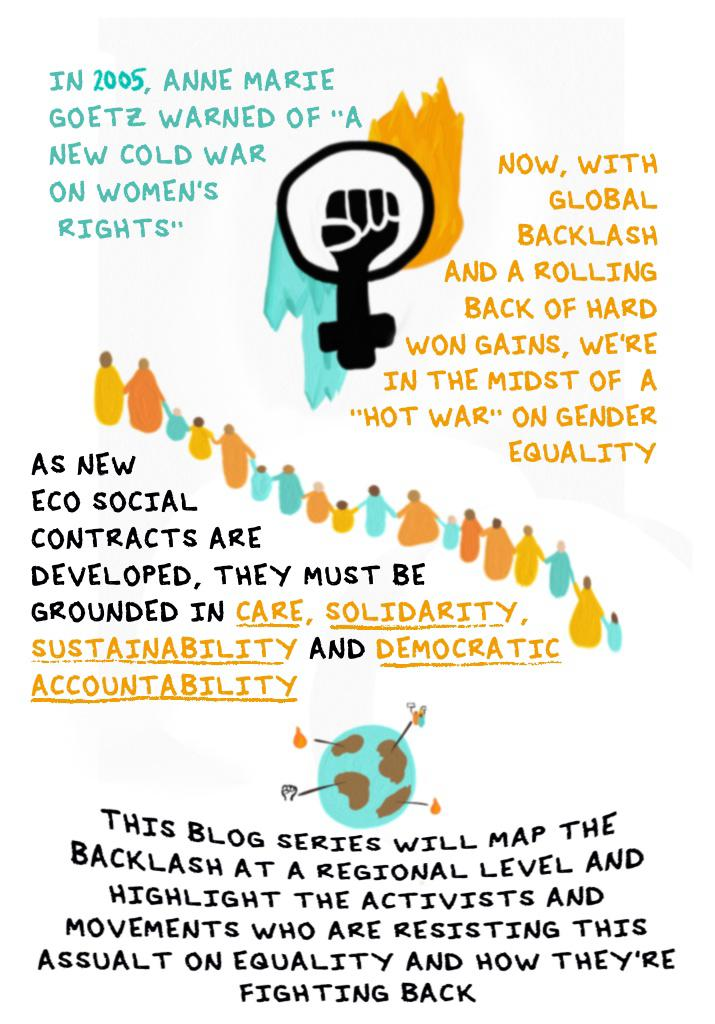
Image credit: Alex Bush
Framing tactics of the backlash
Across these Asian contexts, we observe a shared set of rhetorical and strategic devices used to undermine gender justice.
Cultural relativism: States frame gender justice as a Western imposition that runs counter to national values, allowing them to resist international norms while projecting cultural authenticity.
Family-first discourse: Women’s rights are couched in terms of their utility to the family or nation, reducing feminist demands to instrumentalist functions and reinforcing heteronormative roles.
Securitization of gender: Gender rights are framed as security threats to culture, religion, or social cohesion, thereby justifying state surveillance and restrictions on gender diverse groups.
Obfuscation and dilution: Official documents and statements use vague terminology (e.g., 'empowerment', 'family support') to avoid concrete commitments on contentious issues like bodily autonomy, SOGIESC, or reproductive justice.
Non-state actors’ roles in repression and resistance
In addition to state actors, non-state entities, including religious institutions, far right networks, and civil society groups, play a dual role. While some amplify regressive ideologies and resist international norms, others offer vital resistance and solidarity.
Regressive non state actors: In Malaysia and Indonesia, Islamic clerical councils have issued fatwas against gender diversity. In India, Hindu nationalist groups have protested gender inclusive education and women’s autonomy. These actors influence policy by leveraging moral panic and manipulating public opinion through disinformation.
Progressive civil society: At CSW69, Asian feminist networks such as APWLD (Asia Pacific Forum on Women, Law and Development), CREA, and SAIGE pushed back against this backlash by submitting shadow reports, hosting side events, and making intersectional demands. Their statements underscored the need to centre historically marginalized voices, including Dalit women, trans persons, rural girls, and Indigenous women, who are most affected by patriarchal regression.
Making states accountable
Given the closing civic space and increasing backlash, the following strategies are critical for CSW and allied actors:
Strengthening feminist diplomacy: Progressive states and international agencies must amplify feminist language and offer explicit support to rights-based civil society in Asia. Silence or ambiguity allows conservative narratives to dominate.
Shadow reporting and documentation: Non-state actors should rigorously document human rights violations and policy rollbacks. These can be leveraged during CSW negotiations and Universal Periodic Reviews to name, shame, and pressure governments diplomatically.
South-South solidarity: Asian feminist movements can build stronger coalitions across borders, sharing legal tools, cultural strategies, and resistance practices. Joint statements and collaborative CSW interventions can offset nationalist exceptionalism.
Digital counter-narratives: As the backlash is increasingly spread via digital misinformation, activists must proactively create accessible, localized counter-narratives using social media, community radio, and vernacular storytelling.
Youth and marginalized leadership: Intersectionality must be a lived practice, not a buzzword. CSW and allied platforms should prioritize leadership by queer activists, indigenous women, and youth, who are often the most vocal but under-resourced.
Monitoring funding flows: Several anti-gender movements are transnationally funded, often by religious-right networks in the U.S. or Europe. Exposing these links and demanding greater transparency in NGO financing can curb the spread of organized opposition.
Conclusion
As the world has approached the 30th anniversary of the Beijing Platform for Action in 2025, the continent stands at a crossroads where economic development and political assertion are too often accompanied by patriarchal regression. Gender justice, instead of being an indicator of progress, is being recast as a battleground for cultural identity and national pride.
Yet, amidst the backlash, resistance flourishes in courtrooms, classrooms, communities, and global fora like CSW. The challenge now is to bridge these spaces, reclaim feminist momentum, and hold states to account for their commitments to all women and girls, in all their diversity. The road ahead will require solidarity, courage, and relentless documentation. In the face of authoritarianism, reclaiming the spirit of Beijing means remembering that gender justice is not a Western value, it is a universal right.