
From Beijing, Copenhagen to Doha: Overcoming Africa’s Triple Challenge of Environment, Gender Justice and Development
Updated: Dec 8, 2025
This contribution is part of the GRAN-ESC blog series “The New Hot War on Women’s Rights: 30 Years Post-Beijing.” The series brings together regional and thematic reflections, some of which explore backlash while others focus more broadly on evolving gender equality debates. At the 2025 Commission on the Status of Women (CSW69), which assessed progress on the Beijing Platform for Action adopted in 1995, there was recognition of advances in areas such as girls’ education and women’s political participation, alongside acknowledgement that across most of the 12 critical areas, much remains to be achieved. In a context marked by the rise of right-wing authoritarianism, hard-won gains are also coming under renewed pressure. Through this series, the GRAN-ESC Gender Justice Working Group examines how these dynamics are playing out across different regions and actors.
This blog, highlighting the environment-gender-development nexus from an African perspective, reviews progress and persistent challenges in the implementation of the two inextricable 1995 Declarations, framed within the context of the recently concluded Second World Summit on Social Development.
In the current polycrisis, addressing issues of gender inequality is practically impossible within an economic growth-oriented 20th century social contract. Instead, a paradigmatic normative shift is needed to reconfigure the implicit pacts between individuals, society, and the natural environment. This normative shift is framed within Ubuntu African philosophy to establish a new 21st century gender-sensitive eco-social contract for the continent and the world at large.
Challenges and Achievements: The BPfA and the Copenhagen Declarations
The African Union (AU) Position Document for the Beijing +30 review acknowledges the Commission on the Status of Women as an important UN body for the advancement of gender equality and the rights and empowerment of all women and girls. One notable achievement at the continental level is the progress made by the AU member states in strengthening the institutional mechanism for protecting, promoting and realizing gender equality, women’s empowerment and rights, including the attainment of gender parity in the appointment of Commissioners. While the continent is not on track to fully implement the Beijing Platform for Action (BPfA) or meet the goals of the UN 2030 Sustainable Development Agenda, the establishment of the AU Gender and Youth Directorate, the Centre on Women and Girls Education, and the appointment of an AU Special Envoy on Women, Peace and Security, an AU Youth Envoy and a Special Rapporteur on the Rights of Women in Africa represents meaningful progress.
Commendably, in 2022 according to the International Monetary Fund (IMF), sub-Saharan Africa accounted for more than half of all legal reforms across the world regions for gender equality and protection of the rights of women. The African Charter on Human Rights and Peoples' Rights on the Rights of Women in Africa, also known as the Maputo Protocol adopted in 2003, has supported these policy and legal reforms to institutionalize the rights of African women.
These reforms are attributed to the region’s progress over the past decades in reducing gender inequality, particularly narrowing the gender gap in primary education, although progress has been slower in secondary education. In addition, health outcomes for African women and girls have improved: maternal mortality declined from 727 to 442 deaths per 100,000 live births between 2000 to 2023. Nevertheless, this figure remains high in absolute terms, and accounts for 70 percent of global maternal deaths. With the current reduction rate of 2.2 percent, the African region is projected to have nearly 350 maternal deaths per 100,000 live births by 2030, five times higher than the SDG 3 target of fewer than 70 deaths.
Disturbingly, whilst the Article 4 of the Maputo Protocol recognizes African women and girls' right to life, integrity and security, one of the most fundamental and foundational rights-frequent violation of these rights is not uncommon. In 2022, the United Nations identified Africa as the continent with the highest incidences of femicide. Available statistics indicate that more than 22,000 women and girls on the continent were killed by intimate partners or relatives. This averages more than 54 deaths daily, the highest absolute numbers for any continent. These figures may be an underestimation as South Africa is the only African country that consistently collects data on femicide. Additionally, the South African government is commended for enacting the National Strategic Plan on Gender Based Violence and Femicide (GBVF) and the soon to be established National Council on GBVF. Femicide, reproductive and gender based violence, GBVF undermines progress towards the implementation of the BPfA, the UN Agenda 2030 for gender inclusive and sustainable development and is an obstacle for the AU Agenda 2063: The Africa We Want.
Similarly, in 2024, UNRISD and the South African Research Chair (SARChl) in Social Policy at the University of South Africa (UNISA) convened an online regional consultation. The aim was to gather insights from African Stakeholders to assess progress on the 1995 Copenhagen Declaration and to prepare for the second WSSD. The consultation highlighted advances in education, health, and social protection and identified emerging challenges for the region.
Climate change and environmental degradation have been singled out as intersecting threats to social development on the continent, with the potential to derail previous gains. Compared to other world regions, climate change is already disproportionately affecting the African continent due to a lack of climate change adaptation strategies, leaving communities vulnerable. This is particularly true for those dependent on agriculture and natural resources for their survival, with African women bearing the brunt of climate change.
The challenges noted above highlight the ecological flaws present in the social contract of the 20th century, which aimed to balance the economic imperatives of growth and productivity and the social imperatives of redistribution and social protection. The old social contract, which has now broken down and is unable to sustain the transformative vision of the 2030 Agenda, is also criticized by feminist for reinforcing essentialist and reductive gender inequalities by positioning men as breadwinners and women as dependents.
Driven by the imperatives of economic growth and by a failure to respect planetary boundaries, large corporations colluding with African predatory elites have often deprived peasant farmers, small-scale fishers, and indigenous forest communities, including women, of land, water, and fishing rights. Traditional and ecologically friendly livelihoods have been destroyed as a result of pollution, enclosure and unsustainable, profit-oriented commercial exploitation of natural resources. Women, who often depend on natural resource commons, are disproportionately affected by the devastating effects of climate change and pandemics, which deepen and worsen gender injustices.
Within the current social contract, citizens are increasingly questioning the capacity of their governments to provide protection, security, and well-being. In the African context, as in other developing regions, this crisis of confidence has been exacerbated by the gender-insensitive neoliberal social contract that emerged in the 1970s and 1980s, which emphasized individual responsibilities for personal well-being and social protection.
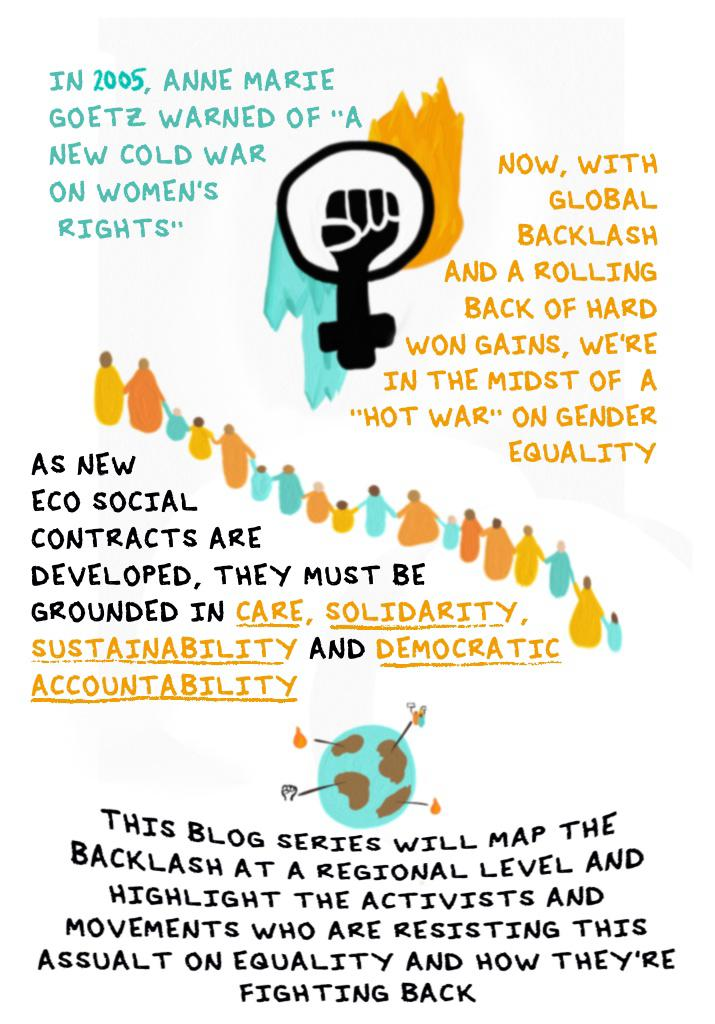
Image credit: Alex Bush
African Ubuntu Philosophy and the 21st Eco-Social Contract for Gender Justice
Overcoming the present challenges and laying the foundation for just and sustainable societies and economies calls for a shift in the norms and values that have underpinned social and economic relations. For Africa, a continent where an ecological and gender just existence is particularly urgent, Esoesa Joy Sowemino stresses the importance of looking beyond western models and philosophies for inspiration.
In such a decentralized knowledge and value system, which is essential for genuinely gender-transformative futures, the African philosophy of Ubuntu becomes central to operationalizing a new global eco-social contract for the 21st century that respects both people and the planet. Africa’s worldview and philosophy of Ubuntu ethics, which emphasizes the harmonious interrelationships between humans and nature, embodies relational ethics that could inspire a new eco-social contract for the 21st century. Such a contract would address the ecological crisis of climate change, driven by the destructive capitalist accumulation of the old social contract of the 20th century, while also promoting gender justice.
Framed within Ubuntu feminism, the 21st-century eco-social contract is envisioned as a framework for gender justice, recognizing that previous social contracts were built on unequal gender relations. From a transformative social policy perspective, the aim is to establish relationships in which the activities of production and social reproduction are equally shared by women, men, and individuals of all genders, thereby balancing hegemonic gender roles. This seeks to reset dominant discourses and uproot relations grounded in patriarchal and extractive cultural norms, thereby reducing inequality in all its dimensions and improving the resilience of women and communities to future shocks and crises.
As Christelle Terreblanche cautions, overcoming the separation between humans and nature – for ecological gender justice requires a battle of worldviews. This battle aims to rebuild and reinvent the very idea of the collective, the communal and the commons, as encapsulated in the philosophy of Ubuntu, after decades of relentless erosion under the neoliberal social contract.
Promising Initiatives: The Agrarian Eco-Social Pact for Zimbabwe
There is not one but many eco-social contracts. Zimbabwe implemented extensive land reforms that address historical injustices, with prospects for an agrarian eco-social pact that has the potential to lead to better social and environmental outcomes. However, those efforts remained insufficient for gender equity, compromising the broader goal of gender justice.
Although there has been marked improvement from previous land reforms, with 18 percent and 12 percent of redistributed land allocated to women in the small-scale and medium-scale commercially oriented sectors respectively, gender-equitable access to land as a productive resource has not yet been fully realized. While this initiative points to the potential for an agrarian eco-social contract, improving gender equality within this new agrarian pact from an Ubuntu gender justice perspective requires a multifaceted approach. This includes gender-inclusive policy development processes that actively ensure women's perspectives and needs.
Conclusion
Addressing the environment-gender-development nexus in Africa is urgent, yet it faces significant challenges that hinder effective implementation of the BPfA, the Doha and the Copenhagen Declaration. Although there have been notable advances in women's rights and gains in representation in governance, persistent issues such as gender-based violence, economic inequality, and inadequate access to education continue to undermine progress. Environmental degradation further compounds these inequalities, disproportionately affecting women, particularly in rural communities.
The implementation of the BPfA, Copenhagen and Doha Declaration, particularly in a context characterized by an ecological crisis, has revealed both progress and gaps, highlighting the need for a more integrated approach that addresses these interconnected challenges. In such a context, the African philosophy of Ubuntu offers a gender transformative framework for addressing the current ecological-development impasse.
Ubuntu emphasizes interconnectedness, communal responsibility, and respect for both people and the environment. By embracing Ubuntu, policymakers can reimagine development as a collaborative process that prioritizes the voices and needs of marginalized communities, particularly for women. This approach can facilitate the creation of gender-responsive environmental policies that empower women as active agents of change. Furthermore, integrating Ubuntu into development strategies can foster a holistic understanding of well-being that transcends individualism and economic growth, promoting social equity and ecological sustainability. By reaffirming commitments to the BPfA, Copenhagen Declaration and the recently concluded Second World Summit on Social Development through the lens of Ubuntu, Africa can pave the way for a more inclusive and resilient future, where gender equality and environmental stewardship go hand in hand, benefiting all members of society.